
If I have a seismic monitoring system in my mine, why would I install additional sensors far away?
It’s a fair question. If your mine is already wired with an extensive, high-density seismic array, adding sensors kilometres away might seem redundant. However, internal arrays have blind spots – not in terms of location, but in terms of magnitude accuracy and external impact.
To address these blind spots, an integrated approach that utilises appropriate sensors both in the mine and in the far field (typically distances >5 km) is crucial. This approach provides three distinct, but interconnected, benefits.
Benefit #1: Achieving Robust Magnitude Estimation: Sensor Type (and Location) Matter
The most critical parameter for any seismic hazard analysis is knowing the true size of a seismic event. If you underestimate the magnitude, your risk models are wrong. Achieving this precision requires a specific type of sensor, ideally placed in a supportive location.
The Technical Challenge: Why In-Mine Geophones Struggle
Standard in-mine geophones (typically 4.5 Hz to 15 Hz) are the workhorses of local monitoring, but they face a couple of fundamental physical “walls” when a large seismic event occurs:
- Low-Frequency Insensitivity: Large seismic events release the vast majority of their energy at very low frequencies. Standard geophones are physically limited in their ability to “see” this low-frequency plateau. Because they cannot accurately record these long-period waves, the resulting data is missing the very component needed to calculate a true magnitude.
- Proximity and Signal Clipping: Because these sensors are installed inside the mine, they are often very close to the event source. The sheer intensity of a large event at such close range can overwhelm the sensor or the data logger, causing the signal to “clip” or saturate. This effectively cuts off the peaks of the seismic waves, destroying the record of the event’s maximum amplitude.
The Solution: The 1 Hz Sensor in the Far Field
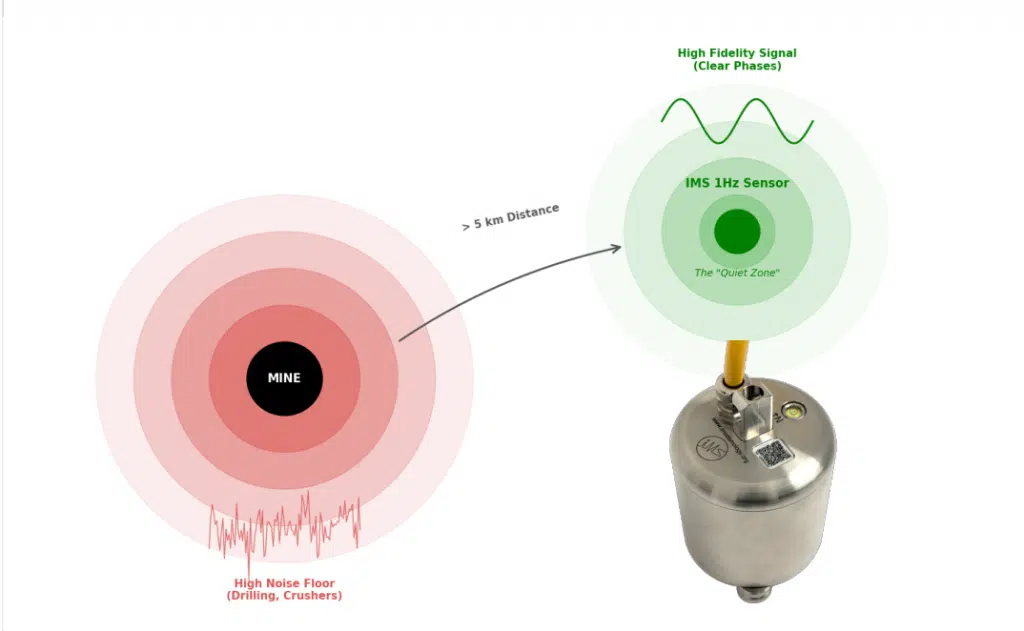
To solve both problems at once, we use a 1 Hz sensor and place it in the far field (typically >5 km away). While the 1 Hz sensor provides the specialised sensitivity required to capture critical low-frequency signals, the far-field location uses distance as a natural filter. By the time the energy reaches a sensor 5 km away, the amplitude has attenuated enough to ensure the signal remains within the equipment’s dynamic range, providing a clean, complete record for analysis.

Benefit #2: Navigating the Complexities of Social and Legal Compliance: A Data-Driven Approach
Seismic events don’t stop at the mine boundary. If your operations are located near local communities or critical civil infrastructure (dams, bridges, or highways), navigating the resultant environment requires objective, traceable, and defensible data.
This aspect is not about validating or invalidating community perception; it is about providing a standardised, data-driven framework for understanding vibration impact.
Fostering Transparent Social License
Vibration is a complex and highly subjective human experience. It is an established scientific fact that humans are extremely sensitive to vibration, with many individuals capable of perceiving movement at levels far below those associated with any risk of structural damage.

When a neighbour experiences vibration from a blast or a major seismic event, they lack context. A report of a “massive shake” is a valid expression of their subjective experience. Without an objective far-field sensor – specifically, a calibrated vibration monitor – the operation also lacks context.
Installing certified vibration monitors (calibrated to international standards like AS2187.2) allows all parties to discuss the event using the same objective metrics, such as Peak Particle Velocity (PPV) or Peak Ground Velocity (PGV). This transforms a subjective concern into a factual, data-driven conversation about adherence to safety standards and compliance limits.
Benefit #3: Safeguarding Critical Infrastructure: Measuring Dynamic Impact
Strategic placement of your far-field sensors can unlock a powerful dual benefit. If a single 1 Hz sensor is installed at critical infrastructure away from the active mining zone – such as a Tailings Storage Facility (TSF) – it does more than just improve source parameter estimation for large mine events.
It simultaneously allows you to monitor the dynamic impact of mining-induced and tectonic seismicity on that specific infrastructure:
- The TSF Use Case: Tailings dams and surface processing plants are highly sensitive to dynamic loading. By having a 1 Hz sensor co-located with this infrastructure, geotechnical engineers can see exactly how the ground beneath the facility responded to a seismic event.
- Proactive Risk Management: Instead of guessing if a distant 3.0 magnitude event affected the TSF, you have the exact waveforms and velocity data to feed directly into your stability models, ensuring the ongoing safety and structural integrity of your most critical assets.
Why Combining These Into One System Makes Sense
The strategic value of this approach comes when you view high-fidelity seismology and environmental vibration compliance within a single, unified system.

By integrating both far-field 1 Hz sensors (for magnitude and infrastructure impact) and standard vibration monitors (for compliance) into one network, you can:
- Streamline Event Attribution: When a stakeholder reports feeling vibration, a unified dashboard instantly links the specific vibration data recorded at the community sensor to the seismic event that caused it. This rapid analysis is essential for transparent, timely communication.
- Ensure Regulatory and Social Confidence: This dual approach ensures the right tool is used for the right job. Your compliance metrics are captured by traceable vibration monitors, providing defensible data for community reporting. Meanwhile, your geotechnical teams benefit from more reliable magnitude estimations and dynamic load data captured by low frequency 1 Hz sensors. Whether you are refining TSF stability models or communicating with neighbours, you are operating from a cohesive reliable source of data.
Conclusion: The “Inside-Out” Strategy
While your in-mine system tells you where and why things are moving underground, an integrated approach that includes far-field 1 Hz sensors and vibration monitors tells you how big the event really was, how much dynamic load your critical infrastructure absorbed, and how it affected the world around you. Together, they create a complete, streamlined, and defensible picture of your mine’s entire seismic and vibration footprint.
