
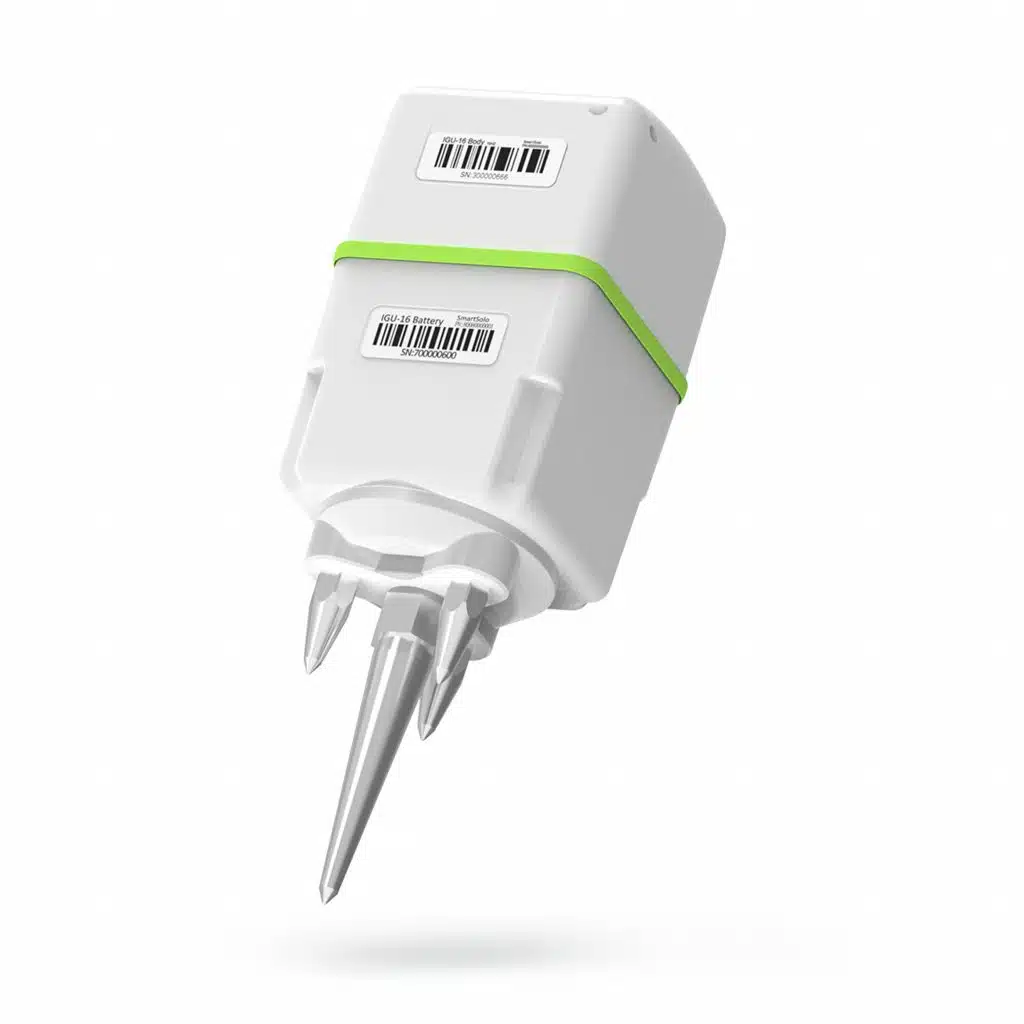
Despite the marginally increased cost, three-component data provides substantial benefits in seismic imaging, and can significantly increase the resolution and accuracy when constructing a seismic velocity model from ambient noise tomography, and provide critical information on the subsurface that is simply not available with vertical-component-only sensors. The availability of the horizontal ground motion data also leaves open the possibility for seismic imaging methods beyond classic ambient noise tomography, providing critical de-risking for large passive seismic surveys.
Some of the advanced imaging methods and unique benefits that can be exploited with three-component data are described below.
Rayleigh wave ellipticity
Rayleigh waves are a type of surface wave that exhibits elliptical particle motion. Rayleigh wave ellipticity, also known as the horizontal-to-vertical ratio (H/V) in the literature, refers to the ratio of the maximum vertical and horizontal displacements during the passage of the Rayleigh wave. In an infinite space, the most simple subsurface model in seismology, the Rayleigh wave ellipticity will take the value of 0.68. The presence of a sharp increase in seismic velocity at depth, however, may ‘squeeze’ the ellipse of the Rayleigh wave motion between the sharp boundary and the surface. This ‘fattening’ of the particle motion will increase the ellipticity of the Rayleigh wave as the horizontal component of motion becomes comparatively larger. In this way, ellipticity measurements are far more sensitive to vertical contrasts in seismic velocity when compared to phase velocity measurements, and provide greater vertical resolution in the resulting seismic measurements.
With vertical-component-only measurements, there is no way to measure Rayleigh wave ellipticity, as the crucial information about the horizontal motion is missing. Only three-component sensors are capable of measuring Rayleigh wave ellipticity.
Rayleigh wave ellipticity measurements greatly improve the vertical resolution and accuracy of a seismic velocity model. Only three-component geophones can measure Rayleigh wave ellipticity.

Love wave phase velocity
Rayleigh waves are not the only type of surface wave common within the ambient seismic noise field. Although the mechanism for their generation is not yet fully understood, a second type of surface wave, known as a Love wave, is invariably present in seismic noise. In some cases, Love waves can even be stronger than Rayleigh waves. While Rayleigh waves display particle motion in both the vertical and horizontal planes, Love waves are confined to the horizontal plane only.
Love waves always travel faster than Rayleigh waves through the Earth. As a result of their faster speed, they exhibit longer wavelengths than Rayleigh waves of the same frequency, and are therefore sensitive to deeper Earth structure. In addition, while Rayleigh wave phase velocity depends upon both P-wave velocity and S-wave velocity, Love waves are only sensitive to S-wave velocity as they are confined to the horizontal plane. By combining observations of both Rayleigh wave and Love wave phase velocity, it is sometimes possible to constrain both the P- and S-wave velocity of the subsurface, especially when Rayleigh wave ellipticity measurements are also utilised. When only Rayleigh wave phase velocity is used, only an estimate of the S-wave velocity is possible.
Three-component geophones also measure Love waves within the ambient seismic wavefield. Measuring Love wave phase velocities improves the accuracy of a seismic velocity model by better constraining the S-wave velocity of the subsurface than Rayleigh waves. Love waves are also sensitive to deeper Earth structure.
Maximise Your Seismic Data
Utilising three-component sensors is the first step toward a more accurate subsurface model. At the Institute of Mine Seismology, we specialise in ambient noise tomography designed specifically for mineral exploration and geotechnical applications.