
When a seismic monitoring system at a mine stops reporting data at 2 am, the response matters. At IMS, support is not an afterthought. It is part of a complete service, delivered by the same team, every time.
Here is what that actually looks like in practice.
How our support service is structured
IMS has support teams in Australia, Canada and South Africa. Each office handles monitoring tickets during local business hours, which means almost all global time zones are covered throughout the working day. After hours, dedicated on-call seismologists and engineers cover both seismological and technical queries, with separate contact lines for each.
That distinction matters. The right technical expertise is available when it counts, not just during business hours.
There is a proper system behind it
The easiest way to reach us is by phone, with regional contact numbers listed on our contact page. You can also log a query via support@imsi.org, where every query is tracked through our support system. Nothing gets closed until it is actually resolved, and we follow up with clients on how each interaction went. Over time, that feedback shapes how we work, and it ensures we never stop improving.
Our monitoring systems also play an active role. When something changes in your system health, such as timing issues or a unit going offline, the system flags it automatically. That notification goes to both the site team and to IMS, so we are often already looking into a potential issue before it becomes a problem. It is part of how we stay ahead of issues rather than just responding to them.
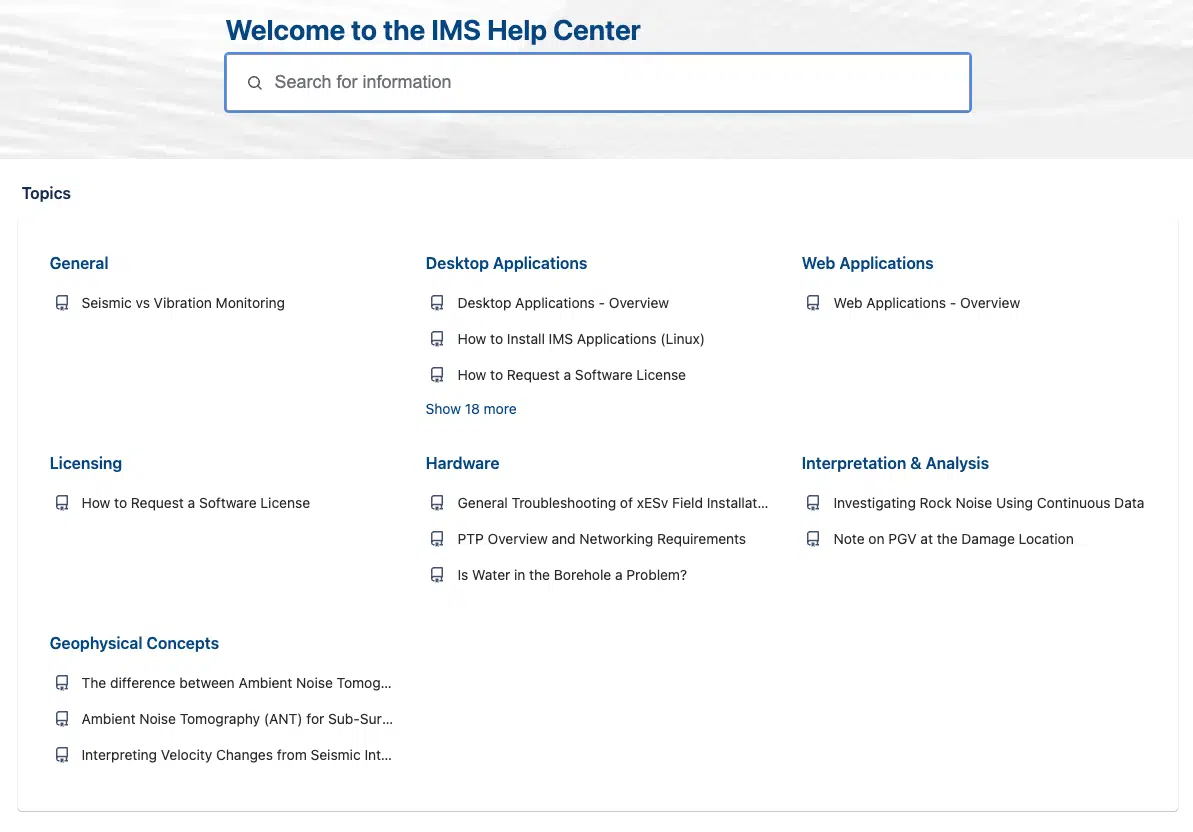
We also maintain the IMS Help Center, which registered clients can access directly. It covers a broad range of topics, from hardware troubleshooting and software installation through to interpretation guides and geophysical concepts. Whether you are working through PTP networking requirements, an xES field installation, or a question about ambient noise tomography, you will find the depth you need here. It is designed so site teams can find what they need without waiting on us, and it reflects the same depth of technical knowledge our support team draws on every day. If you are not yet a registered client, you can register directly through the IMS Help Center: https://support.imsi.org
Relationships: the part that is harder to explain
Good tools and structured workflows matter, but they are not what make the biggest difference. What matters most is the knowledge and context that builds up over time, and the relationships that come with it.
Clients are usually supported by the same people over time. That means when something goes wrong, you are not explaining your operation to someone who has never heard of your site. The person on the other end already knows your history, your setup, and the kinds of issues that tend to come up. Diagnosis is faster, communication is clearer, and there is less disruption at site level.
Some of those relationships have been running for so long that the line between professional contact and genuine friendship becomes a blurry one. That is not something we set out to achieve. It is what happens when the same people show up, year after year, through the same technical challenges.
Why this matters
Seismic monitoring only delivers value when the system is working reliably and when people trust the data it produces. That trust is not built through a ticketing system. It is built through consistent technical expertise, genuine familiarity with your operation, and knowing that when something goes wrong, the right person is already across the problem before the conversation even starts.
That is what the IMS support model is built around, and it is why clients who come to us for a complete monitoring solution tend to stay.
